1.2 Significance And Relevance Of Foreign Investment Into China

Page Completion Estimate = 2 Hours
1 Introduction
FDI has been one of the most important aspects of the overall economic reform program launched in China forty years ago. The gradual but active liberalization of the FDI regime and improvements in the investment environment greatly increased the confidence of foreign investors to do business in China. Consequently, FDI inflows into China increased rapidly after 1978 and particularly during the 1990s. In 2002 with China’s accession to the World Trade Organization (WTO) China became the largest FDI recipient in the world (Chen, 2012). In order to place the research on the determinants of the strategic decision-making process on market entry into China by Dutch companies in perspective, a profound understanding of China’s position on FDI, the historic development, significance and relevance to the contribution of the development of China’s economy is a prerequisite. This chapter elaborates on the role of FDI in the Chinese reform strategy and highlights the characteristics that are specific to the Chinese context followed by an overview of FDI developments since the commencement of China’s economic reforms. During past forty years China has been reforming its economy moving away from a demand economy and developing towards an open market economy. Chinese FDI trends can be distinguished according to changes in policy directions of which the foundations are discussed in this article.
2 Agricultural Reform as Platform for Future Reforms
From the establishment of the People’s Republic of China (PRC) in 1949 to the adoption of economic reforms in 1978 there was almost no foreign investment in China. The year 1978 marks the beginning of China’s reform. China’s transformation of its economic system was primarily seen in the breakthrough in its administrative decentralization and incentive policies. In the agricultural sector the communes were abolished, and the household responsibility system was established through which collective land was assigned to individual households thus allowing farmers the freedom of land-usage and decision-making rights. This new system generated incentives for production by linking rewards closely to performance and local governments took a strong initiative of transferring production decisions and profits from communes to households. As a result, China’s agriculture sector dramatically revived. Agricultural reforms became the platform of the reforms for the entire economy, providing a sound basis for undertaking a series of industrial reform. In the industrial sector companies were given discretion with respect to production, profit retention and profit distribution by the introduction of a massive incentive program, the Contract Responsibility System (CRS) in the early 1980s. Companies were able to run their operations freely with increased availability of internal funds. Consequently, productivity and efficiency were greatly improved.
2.1. Corporate Ownership Reform
Since 1990 ownership reform has been undertaken with the target of establishing a modern corporate system of shareholding companies. At the time of reform China encompassed an approximate 16,500 State-Owned Enterprises (SOEs) of which 500 were considered as “sanctum sanctorum” of the command economy (Ghosh, 2006). During the reform many large- and medium-sized SOEs were spun off, restructured into shareholding companies in one way or another and went public on stock markets. The majority of the newly listed companies were of hybrid ownership which were mainly composed of non-tradeable state shares, legal person shares and public shares. Non-state-owned enterprises were also given the opportunity to list on stock markets. With the Security Law that governs public listing taking effect in 1998, the private sector gained more equal access to stock markets. Thus, the ownership reform has brought about significant changes in the corporate structure and fostered the development of a non-state sector.
2.2 Financial System Reform
Subsequently the structural changes in the agricultural and industrial sectors have driven the changes in the financial system. Since 1984 the state-owned banks have been assigned the task of administering the financial operations of the corporate sector. This was the first step for Chinese banks in the shift towards a modern financial investment system. At an early stage of transition the major role of the banking system was restricted to directing the interest bearing loans from the government to achieve the government objectives of facilitating the development of the industrial sector and supervising the use of funds by enterprises in accordance with the central plans (Tam, 1986). With the commercialization of the banking system promoted in 1992 decentralization of credit controls and the development of other financial institutions have helped to channel financial resources to a broader range of sectors.
To meet the increasing demands for capital from the corporate sector two stock exchanges, the Shanghai Stock Exchange and the Shenzhen Stock Exchange, were established in the early 1990s. Herewith Chinese firms were provided with opportunities to raise capital from domestic and foreign investors as a substitute for continued central government funding and bank credits to finance their capital investment. The Shenzhen Stock Exchange inaugurated a new board for SMEs in 2004 to help further ease SME finance. The SME Board is open to SMEs with outstanding main business or innovative high-tech start-ups. Its primary function is to facilitate the financing of the growing SMEs that needs funds that have few fund-raising channels. Overall, increased reliance on sources other than the government’s budgetary finance indicated that the development of the financial markets brought about significant changes to corporate financing patterns and that the financing channels have been diversified. Since the 1990s a rapid emergence of financial products ranging from short-term commercial credits to long-term equity capital and corporate bonds took place. The functioning development of various financial institution and instruments was believed to improve the availability and allocation of capital resources to the corporate sector facing financing constrains in their investment activities.
During the first twenty years of economic reform, notwithstanding the progressive removal of legal disabilities, the private sector continued to face discrimination from the banking system in the matter of availability of credit. Such persisting financial discrimination was the outcome of a well-entrenched and institutionalized ideological hostility towards private enterprises, making it difficult, if not impossible, except with the courtesy of political connections to access resources from the banking system. The hierarchical order that the banking system had been following was patently political rather than economic with the state-owned enterprises at the top, collective firms in the middle and the private firms at the bottom position. This kind of prioritization resulted in credit restraints for the private sector which was in place not because private enterprises were inefficient but because they were private. Until 1998 the largest Chinese banks were under instruction not to lend to private firms. Only on 1 July 2001 at the eightieth anniversary of the founding of the Communist Party of China (CPC) the then General Secretary Mr. Jiang Zemin produced a speech proceeding from the perspective of the law of historical development and the need to advance with the times which resulted in broader acceptance of providing financial aid to China’s private sector.
One of the landmarks in strengthening the role of the financial sector in channeling financial resources is that the government came to recognize the need to push forward the strategic development of tertiary industry and SMEs and made important efforts to improve the credit environment for these sectors. To support the SMEs some specialized service systems at the local government level were established and were enabled to provide supporting loan systems. In 2001 the Provisional Regulation of SME Credit Guarantee System and the Management Methods of Credit Guarantees for SMEs were published to stress government support in SME financing. The priority of the SME sector is further highlighted in the PRC Small- and Medium-sized Enterprise Promotion Law promulgated in 2003 which reaffirms that the government will reinforce and ameliorate the system of services to give legal protection to the SMEs’ financial interests to foster the sustainable growth of the SME sector (Jia & Dong, 2009).
3 FDI as the Preferred Instrument for Change
At the initial stages of the reform China’s new government had to identify and select an effective and efficient instrument of change given the compulsions to grow fast and to establish the legitimacy of the decision to discontinue the old prevailing ideology. SOEs were by far the dominant force in the Chinese economy at the start of the country’s economic reform. SOEs employed approximately thirty million workers herewith accounting for four-fifths of total economic output and owning the vast majority of the machinery, equipment and other physical assets employed in manufacturing. However, SOEs could not be considered for assuming leadership roles in the competitive global economy as for decades SOEs had been accustomed to function in accordance with the dictates of the government, resulting into institutional deficiencies too deep rooted across the whole spectrum of the Chinese economy. SOEs and the supportive financial system had been utilized for years by the state and the party directly to influence resource allocation in a command economy. In economic terms SOEs had become virtually bankrupt. SOEs were effectively borrowing large sums of funds from state-owned banks and burdening the banking system with huge non-performing loans (Ghosh, 2005).
Implementation of major institutional reforms would have required the state and the party to surrender a great deal of economic and political power which could have led to unpredictable consequences, presumably threatening the stability of China’s governance itself. China’s new government realized that before it would be in the position to push forward a coordinated reform strategy encompassing state enterprises, the financial system and tax administration a safety mechanism for the large and dynamic non-state sector had to be established (Steinfeld, 1998).
China’s new government found itself in a challenging position given the fact that the institutional foundations for the growth of domestic enterprises were virtually non-existent and that the Chinese entrepreneurial tradition had been suppressed during the Maoist regime. China did not possess capabilities in many modern industries and had to look for ways to encourage an investment regime that could give it the benefit of an unsurpassable edge in scale of economies, market reach and technological leadership. The contemporary counterpoint existing in the form of the Washington Consensus, a market-based model in which the private sector acted as the key and principal agent with assured property rights and established rule of law, was considered inappropriate in the Chinese context. With no viable and credible local economic agent to turn to China’s new government accepted in recognition of economic realities that FDI could be deployed as a kind of change agent.
3.1 Governmental Support for FDI
With the promulgation of the amended version of the Constitution of the People’s Republic of China on 4 December 1982 protection was offered to the legal status of foreign enterprises operating in China. The amended Constitution includes provisions which permit foreign enterprises, other foreign economic organizations and individual foreigners to invest in China and to enter into various forms of economic co-operation with Chinese enterprises and other economic organizations in accordance with the law of the People’s Republic of China. All foreign enterprises and other foreign economic organizations in China as well as joint ventures with Chinese and foreign investment located in China shall abide by the law of the People’s Republic of China. Their lawful rights and interests are protected by the law of the People’s Republic of China (NPC, 2004).
On 12 April 1988, the Constitution of the People’s Republic of China was amended to include a new paragraph in which the Chinese government permitted the private sector of the economy to exist and develop within the limits prescribed by law. By means of the amendment the private sector of the economy became to be considered as complement to the existing socialist public economy. The Chinese government further provided legal protection to the lawful rights and interests of the private sector of the economy. On 15 March 1999 further amendment of the constitution took place elevating the position of the individual and private sector in the Chinese economy. In the new version of the Constitution the individual, private and other non-public economies that exist within the limits prescribed by law are considered major components of the socialist market economy.
3.2 Management of FDI Inflow
The policy changes made over the last forty years to accommodate the inflows of FDI have been dictated substantively by the overriding objective. Relaxation of the investment climate came in phases though in fairly quick succession. The measures announced during the 1980s were limited in their scope and range. In January 1992 the then CPC General Secretary Mr. Deng Xiaoping visited China’s southern coastal areas and Special Economic Zones (SEZs) with the purpose to push China’s economic reform process forward. During the visit China’s commitment to the open-door policy and market-oriented reform was emphasized resulting in obtaining the confidence of foreign investors in China. As the amendments made to the Constitution in 1982 produced encouraging results, the Chinese government in 1992 decided to adopt a new approach on developing the inflow of FDI. It decided to turn away from special incentive regimes and move towards a more nation-wide implementation of open policies for FDI. Simultaneously transferring the investment approval authority was shifted from the central government to local governments. As a result of change in policy the inflows of FDI strongly accelerated.
4 Addressing regional economic disparities
Economically and administratively China has been divided into three regions, namely Eastern, Central and Western. The Eastern region includes the provinces of Beijing, Tianjin, Hebei, Shandong, Liaoning, Shanghai, Jiangsu, Zhejiang, Fujian, Guangdong and Hainan, which comprise the coastal regions and the SEZs first promoted for foreign trade and investment. The Central region includes the provinces of Shanxi, Jilin, Heilongjiang, Anhui, Jiangxi, Henan, Hubei and Hunan, just adjacent to the Eastern region. The Western region includes the provinces of Inner Mongolia, Guangxi, Hongqing, Sichuan, Guizhou, Yunnan, Tibet, Shaanxi, Gansu, Qinghai, Ningxia and Xinjiang, which is adjacent to the Central region and separated from the coastal region by the Central region.
From the chronological description above, the initiating policies and geographical starting points of the promotion of FDI inflow into China it has become evident that geographical bias by means of the initial focus on coastal regions has resulted in imbalances in development levels in terms of both volume and quality of investments. In order to reduce regional disparities and accelerate economic development from 2000 onwards China actively coordinated development strategies and policies for its central and western regions (Zheng & Xiang, 2011).
Underlying this unbalanced growth experience are multiple factors, an incomplete list of which encompasses (Taube & Ögütçü, 2002).
- Political reasons including the role a region has been attributed in the reform process, the degree of local autonomy from central government, the degree of reform mindedness and entrepreneurial spirit of the local administrative bodies;
- Historical reasons including parameters such as the involvement in former economic policy campaigns, the third front strategy and the resulting effects on the local industry;
- Structures, and the emigration of parts of the population, which prospered in other regions of the world; and
- Geographical reasons including the existence of natural resources, access to the seaports and inland waterways.
In January 2000, the Chinese government launched “the Western Development Strategy” (Lai, 2002). “The Western Development Strategy” constitutes a cornerstone of the Tenth five-year plan (2001-2005) and has been an ambitious top-down effort to steer state investment, outside expertise, foreign loans and private capital into the parts of China most in need but least likely to attract aid on their own. This highly ambitious program is not undisputed. Critics point out that increased government spending in the west will reduce the amount of money available for current social programs, health, education and welfare, thereby aggravating the problems in these areas of China’s contemporary development process. In the perception of some foreign enterprises the program is not addressing all the main issues at stake for foreign investments in the region. In addition, it has been recognized that the benefits of westward development could take generations to materialize (Lai, 2002).
4.1 China’s FDI Policy
The Chinese government screens FDI projects in accordance with laws on each category of foreign ownership, including the 1979 Law on Sino-Foreign Equity Joint Ventures, the 1986 Law on Wholly-Foreign-Owned Enterprises and the 1988 Law on Sino-Foreign Contractual Joint Ventures. In addition to these laws China operates a catalogue system that combines elements of both open and closed lists. The Catalogues for Guidance of Foreign Investment Projects have four categories, namely prohibited, restricted, permitted and encouraged. The permitted catalogue is not published. The prohibited catalogue is effectively a negative list detailing sectors in which foreign investment is not permitted. The restricted catalogue contains sectors in which foreign investment is permitted but in which the project examination and approval process may be stricter and take longer. It includes some sectors opened to foreign investment as a result of China’s WTO entry. The encouraged catalogue projects are given favorable treatment because they comply with China’s development policies which are focused on promoting high-technology, capital-intensive industry as well as development in the Central and Western regions (Davies, 2012).
4.2 China’s FDI Diplomacy
Since early 1980s China has pursued active investment diplomacy as it has signed 145 bilateral investment treaties (BITs), 23 Treaties with Investment provisions (TIPs) and 21 Investment Related Instruments (IRIs) by July 2018. China has signed over 100 Agreement on Avoidance of Double Taxation (DTA), more than 10 tax information exchange agreements (TIEA) and one multilateral convention of mutual administrative assistance in tax matters. The DTA’s of China basically followed the Model Treaty Convention of the OECD. China is a member of the WTO since 2001 and a member of the ASEAN-China Free Trade Area (AFTA) since 2010 (UNCTAD, 2018).
5 Effects of FDI on Private Sector Developments
FDI results in a positive spill over effect in enhancing industrial productivity level in China (Zhao & Zhang, 2010). At the beginning of China’s economic reform FDI replaced many independent business units that were performing contract production for foreign firms. The increase of FDI was being accompanied by a continuing decline in contractual arrangements that domestic entrepreneurs had earlier established with foreign buyers. This trend sharply contrasted from what has been observed in other developing countries, where local investors learned the skills and crafts the production of labor-intensive export products and displaced the foreign producers. Since there were no strong domestic business groups in China with whom foreign investors could form productive alliances and China’s government did not allow any kind of sensitivity about a foreign presence to cloud their judgment about the limited capability of the domestic entrepreneurs in accessing the kind of finance and marketing skills that were required in a global market, throughout the 1980s and 1990s foreign investors were allowed to perform the role of venture capitalist without restrictions. As a result, hereof they provided equity financing to private enterprises disregarded by China’s formal financial institutions. Directly and through joint ventures FDI helped to develop the position of Chinese private enterprises. Without the support of FDI these organizations would have atrophied under the weight of China’s inefficient financial and economic institutions. With the benefits resulting from FDI inflow accruing to the economy the Chinese government felt encouraged to steadily introduce concepts and institutions of private property into the Chinese economy. China has been witnessing increasing confidence among entrepreneurs that the state will not confiscate one’s property resulting in an upsurge of new businesses across almost all industries.
Following the visible benefits from FDI China’s government felt increasingly comfortable in allowing significant relaxations in the prioritization order applicable within the banking system. Domestic enterprises were given greater access to the banking system for the financing of contractual arrangements resulting in a rapid increase in subcontracting and export operations undertaken by domestic private enterprises. This increased 82-fold from 1996 to 2000 (from USD 6 million to USD 526 million). Initially FDI inflows were mainly restricted to the collectives and joint ventures in provinces and selected regions. As China started to enjoy benefits resulting from FDI in combination with the establishment of domestic entrepreneurship the Chinese government could afford readdress its focus. During the fifteenth Communist Party congress in 1997 the then CPC General Secretary Mr. Jiang Zemin declared that the state did not have to dominate every sector or have majority ownership in every enterprise in order to maintain broad control of the economy. The Chinese government decided to focus only on a few enterprises and privatize those that did not fall in this key category. The government announced its policy of “grasping the big and letting go the small’. “Grasping the big” meant restructuring and consolidating China’s largest SOEs and “letting go the small” meant that the government committed itself to support privatization of small SOEs. This is attributable to the benefits that the domestic firms received from the inflow of FDI. The domestic firms can derive technological know-how and the demonstration effects on innovation activities via the inflow of FDI (Cheung & Lin, 2004). Furthermore, the inflow of FDI is crucial for China as investment is the main component of China’s GDP which accounted for more than 40 percent (Boumphrey, 2014).
6 Major types of FDI in China
The main types of FDI in China are Equity Joint Ventures (EJVs), Contractual Joint Ventures (CJVs) and the establishment of Wholly Foreign Owned Enterprises (WFOEs). Contractual joint ventures were initially the most important FDI type since the late 1970s. Since the late 1980s EJVs and WFOEs became predominant investment vehicles. Recent years have seen a proliferation of WFOEs. EJVs have been a popular entry mode for two reasons. First, the Chinese government is of the opinion that EJVs best serve the Chinese objectives in regards of foreign capital, technology, and management experiences. Second, foreign investors aim through engaging in joint ventures to obtain local partner’s assistance in the domestic markets (Zhang, 2002). Deng (2001) notes that many foreign investors have chosen WFOEs as the preferred entry mode in recent years so as to avoid problems associated with equity joint ventures. Multinationals that used to form JVs with domestic enterprises started to establish WFOEs to strengthen corporate control, improve efficiency and better co-ordinate corporate resources. According to Yunshi and Jing (2005), from 1984 onwards the number of incorporated WFOEs has been increasing.
Between 1997 and 2001, more than 50 percent of newly incorporated firms were WFOEs. The proportion of investment by means of JVs decreased from more than 50 percent before 1994 to 31.5 percent in 2000 (Yunshi & Jing, 2005). Even at those JVs, foreign shareholders have tended to increase their investments to wield greater corporate control. This is in line with the development strategies of multinationals that have boldly entered the Chinese market to strengthen their control. By forming a corporate network, they reduce overall costs of their operations and optimize their local presence.
7 The growth of FDI inflows into China
In line with China’s economic reform calendar discussed in previous paragraphs the growth of FDI inflows into China during the past forty years from 1978 to 2018 can be broadly divided into three distinct phases, namely the experimental phase from 1978 to 1991, the strong development phase from 1992 to 2002 and the post-WTO phase from 2003 onwards.
7.1 1978 to 1991: The First Phase
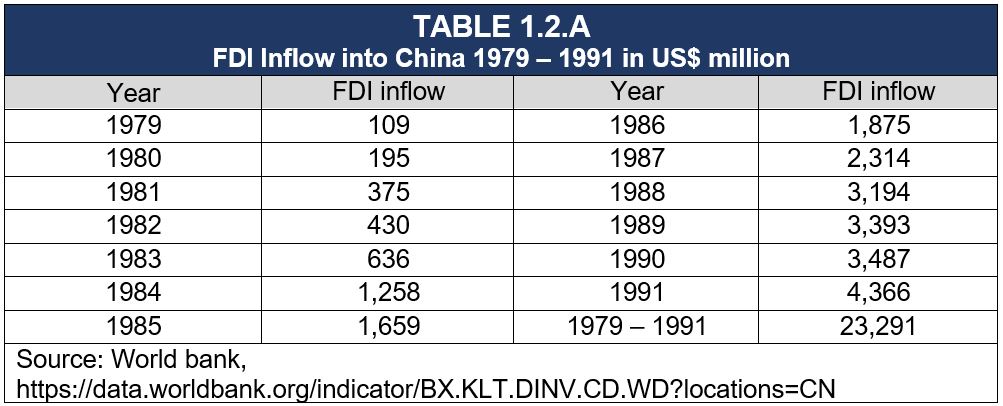
In the First Phase the Chinese government established four SEZs located in South China in Shenzhen, Zhuhai and Shantou in Guangdong Province and in Xiamen in Fujian Province. It offered special incentive policies for FDI in these SEZs. FDI inflows were as a direct result hereof highly concentrated in Guangdong and Fujian provinces. The commencement of FDI inflow started with the promulgation of the Law on Sino-Foreign Equity Joint Ventures in July 1979 providing the legal framework for foreign investors to participate as joint venture partners with Chinese partners (Fu, 2000). Foreign affiliates were required to export their entire output. China lacked the basic elements of an institutional framework for foreign investment such as adequate physical infrastructure, a mobile labor force, internationally acceptable accounting practices and the rule of law. In compensation China offered fiscal incentives to foreign investors in the SEZs, including a five-year tax holiday and a halving of the rate of business income tax (Davies, 2012). During the initial period of the first phase the Chinese government was very cautious about introducing FDI into its domestic economy and vice versa foreign investors were also cautious about performing investments in China. This resulted in the fact that the amount of initial FDI inflow was rather limited.
In 1984 Hainan Island and fourteen coastal cities across the provinces of Liaoning, Hebei, Shandong, Jiangsu, Zhejiang, Fujian, Guanxi and Guangdong, as well as Tianjin Municipality and Shanghai Municipality opened to FDI. Special economic policies were introduced and as a direct result hereof inflows of FDI in 1984 doubled compared to 1983. The subsequent seven years resulted in a cumulative inflow of FDI due to the opening up of new areas and regions, including the Yangzi River Delta, the Pearl River Delta, the Min Nan Region, the Shanghai Pudong New Development Area and the entire coastal region. To further encourage FDI a series of new laws and regulations was introduced with considerable success. Notably the Law on Enterprises Operated Exclusively with Foreign Capital and Provision on Encouraging Foreign Investment in 1986 lifted restrictions on foreign ownership, implemented new incentives and remove uncertainties for foreign investors. After the world’s largest consumer population became an available market most of the world’s largest multinational enterprises (MNEs) set up operations in China.
Table 2.1.1 A illustrates the development of FDI inflows into China over the period of 1979 to 1991.
7.2 1992 to 2002: The Second Phase
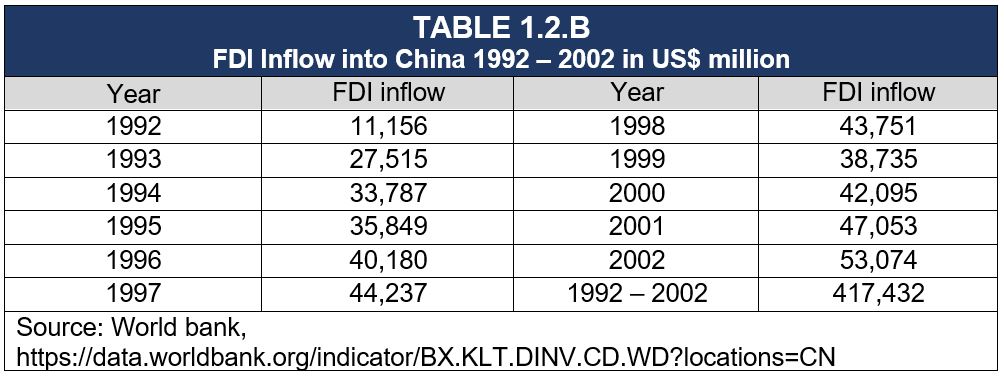
Following the visit of the then CPC General Secretary Mr. Deng Xiaoping to China’s southern coastal areas and SEZs with the purpose to push China’s economic reform process forward, to emphasize China’s commitment to the open-door policy and market-oriented reform, FDI inflows strongly increased year-on-year.
During the 1990s as FDI inflow accelerated and operating conditions improved China relaxed many restrictions. Wholly Foreign Owned Enterprises (WFOE) were allowed and became popular among foreign investors. Export requirements relaxed and sales to domestic consumers became allowed. China’s high growth phase in FDI inflows was followed by the ascension of China to the WTO. China adopting policies to boost transparency, improving intellectual property protection, reducing tariffs and taxes and privatizing state-owned enterprises, resulted in an increased confidence in China by foreign enterprises. As a direct result hereof the subsequent influx of FDI became more myriad by sectors and source countries (Yong et al., 2016).
Table 2.1.1.B below illustrates the development of FDI inflows into China over the period of 1992 to 2002.
7.3 2003 to present: The Third Phase
The FDI inflows into China continued to increase progressively year-on-year during the first years of the third phase until the start of the global economic crisis in 2008 which had a negative effect on the volume of FDI inflows in 2009.
8 Effects of the 2008 Global Economic Crisis
China was less seriously affected by the global crisis than its main trading partners. The country’s exposure to the US sub-prime market was relatively small and the collapse of consumer confidence in the US had a limited effect on China’s exports (Deutsche Bank, 2008). The Chinese government initiated an early and rapid-acting stimulus package that helped support continuous growth (EIU, 2009). FDI inflows into China almost certainly decreased not because of any fear of market shrinkage in China were GDP grew with 9,6 percent in 2008 and 9,1 percent in 2009, but because of home country financing problems. Although no cancellation of large foreign investments has been made public several foreign affiliates have suffered domestic problems and are likely to suffer as well as dampening or delayed planning for overseas expansion.
9 Effects of the Worldwide Economic Slowdown
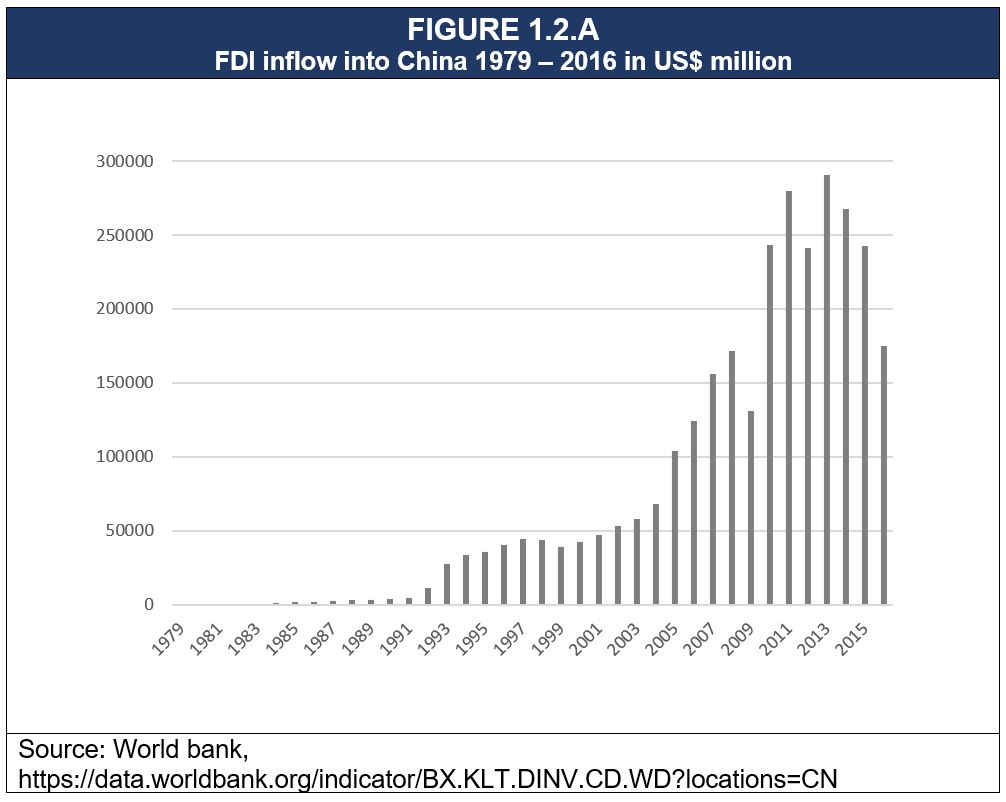
Table 2.1.1.C below illustrates the development of FDI inflows into China over the period of 2003 to 2016 and Figure 2.2.6 A illustrates the FDI inflow into China over the period 1979 to 2016. In 2010 FDI inflows into China recovered and exceeded the level of inflows recorded in 2008 prior to the global economic crisis. When adjusted for the effects of the 2008 global economic crisis, the year-on-year increase of FDI inflow has been in line with past years development trend.
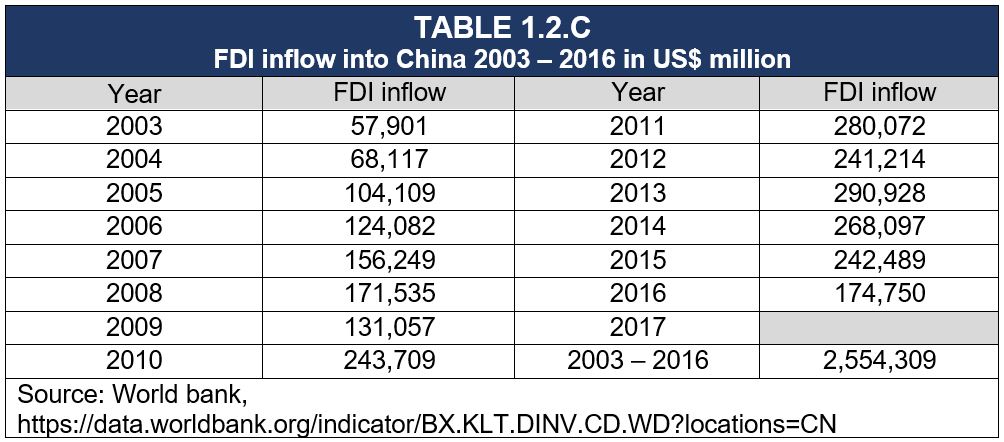
In recent years China has experienced a slowdown in economic growth influenced by a maturing state of the country’s economy and influences of international trade development. Over the period 2011 to 2016 the progressive FDI inflows into China flatten out in 2013 further followed by a decrease in inflows in 2014 to 2016. China’s annual growth target in the twelfth five-year plan (2011-2015) was 7 percent and the newly approved thirteenth five-year plan (2016-2020) includes 6,5 percent. The decrease in growth in nominal terms reflects the rebalancing of the economy and the focus on the quality of growth while still maintaining the objective of achieving a doubling of GDP for 2010-2020 (Worldbank, 2017). The rebalancing of the economy and the focus on the quality of growth has been underlined by China’s recent reaffirmation of its commitment to globalization and international trade. The country is in the process of progressively reforming its current FDI landscape. Reform is found in the form of revision of the foreign investment law, simplification of corporate establishment procedures, expansion of the number of Free Trade Zones, enhancement of IP protection, tax reforms and cuts as well as implementation of measures to further attract human resources.