Certificate Course
Labor Law Compliance In China
Develop a practical understanding of China’s labor law framework, including employment contracts, working conditions, employee rights and employer obligations.
Learn how to identify compliance requirements, manage employment risks and apply China’s labor regulations effectively in your organization.
Certificate Course
4 weeks
approx. 4 hours/ week
100% online
Open Enrollment
EUR 499
Course Overview
The “social” pillar of ESG is becoming increasingly important in China, where companies are expected not only to comply with labor and employment regulations but also to demonstrate responsible practices toward employees, communities and business partners. For foreign enterprises, understanding China’s evolving labor framework and broader social expectations is essential to managing compliance risks, protecting corporate reputation and building sustainable stakeholder relationships.
This certificate course provides a structured understanding of China’s labor and employment framework and its broader social implications for businesses. Across four units, the course examines key areas including labor rights, employment practices, diversity and inclusion, supply chain responsibility and community engagement. Participants will develop a practical understanding of how regulatory requirements and societal expectations shape responsible employment practices in China.
Drawing on real-world cases involving companies, the course combines regulatory analysis with practical examples and strategies. By the end of the course, participants will be better equipped to identify labor and social compliance risks, strengthen responsible employment practices and integrate social considerations into their ESG approach in China, while balancing international standards with local regulatory and business realities.
Course Structure
Five Focused Units.
Unit 1: Introduction
The first unit provides an orientation to the course and the online learning environment. The unit does not carry credits. You are encouraged to go through the materials at their own pace to get accustomed to the online medium.
Unit 2: The Foundations of Chinese Labor Law
This unit introduces participants to the structure of China’s labor law system, emphasizing the interplay between national legislation and provincial enforcement variations. Learners will explore the role of administrative bodies, including the Ministry of Human Resources and Social Security (MOHRSS), and examine trends in labor law enforcement, particularly in sectors connected to global supply chains. Activities include mapping exercises that compare central regulations with local interpretations, providing participants with a clear understanding of how the legal framework functions in practice.
Unit 3: Employment Contracts & Legal Risks
Unit three focuses on the various types of employment contracts in China, including fixed-term, open-term, dispatch, internship, and outsourced labor arrangements. Participants will learn to differentiate between these contracts and assess the legal risks associated with each, including hidden obligations and potential liabilities. Practical exercises involve reviewing real-world contracts to identify compliance gaps and understand how contract structure impacts day-to-day operations.
Unit 4: Wages, Overtime, and Workplace Protections
In the next unit, the course examines wage policies, overtime calculation, holiday pay, social insurance contributions, and workplace injury protections. Participants will evaluate company policies against legal requirements and identify areas of potential non-compliance. Hands-on activities, such as auditing sample company policies, help learners develop the skills to ensure that employment practices are aligned with Chinese labor laws while protecting both employees and business continuity.
Unit 5: Compliance Failures and Internal Risk Management
The final unit explores real-world examples of labor compliance failures in foreign-invested enterprises. Participants will analyze root causes related to supplier management, subcontracting, and documentation gaps, gaining insight into common pitfalls and preventative strategies. The module concludes with practical exercises in designing internal compliance mechanisms, including employee grievance channels, labor audits, and corrective action plans, equipping learners to proactively manage labor-related risks within their own organizations.
Who Is This Course For?
This course is designed for professionals responsible for HR, employment, compliance and ESG-related matters in China, particularly those working for foreign-invested companies or international organizations.
- HR professionals and China HR Managers
- Country managers and senior executives
- Legal and compliance professionals
- ESG and sustainability professionals
- Business owners and managers overseeing employees or operations in China
- Professionals who need to understand how China’s labor regulations and social expectations affect responsible business practices
Practical Tools Included
The course combines regulatory knowledge with practical tools that participants can use to assess and manage labor and social compliance in China, including:
- Labor Law Compliance Checklist: Key areas to review when assessing compliance with China’s employment and labor requirements.
- Employment Practices Assessment Tool: A practical framework for reviewing workplace policies and employment practices.
- ESG Social Risk Assessment Framework: Identify and assess social risks related to employees, suppliers and other stakeholders.
- Diversity & Inclusion Checklist: Key considerations for developing responsible and inclusive employment practices in China.
- Stakeholder Engagement Framework: Guidance for identifying relevant stakeholders and structuring engagement with employees, communities and business partners.
Earn Your Credential
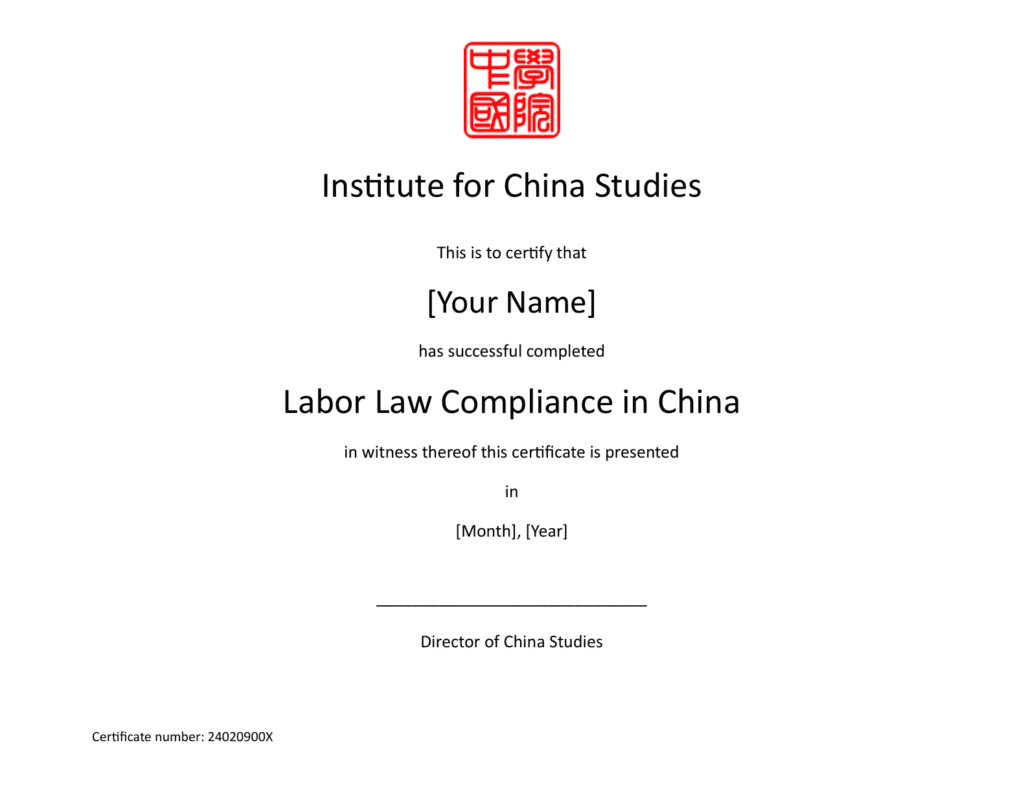
Upon successful completion of the masterclass and the required assessments, you will earn a digital certificate of completion from the Institute of China Studies.
Your certificate provides a formal record of your completion of the program and can be retained as part of your professional learning portfolio.
Official Recognition
Issued by the Institute for China Studies.
Digital Format
Easy to download, share and add to your profile.
Your Course Professor

Dr. Richard van Ostende, DBA
Richard van Ostende is founder of the Institute for China Studies. He combines extensive professional experience and practical expertise in corporate finance, foreign investment and business strategy.
Not Sure Where To Start?
Book a free consultation with us.
Choosing the right program or solution for your organization can be challenging. Speak with an ICS advisor to discuss your objectives, experience and requirements.
Not Sure Where To Start?
Looking for an answer?
You may find the information you need in our Frequently Asked Questions, covering programs, admission, learning pathways, certification, fees and more.
Related Courses
Continue developing your China expertise.
Related Courses
Continue developing your China finance expertise.