Certificate Course
China Secondment: Tax Implications for Cross-border Labor Dispatch
Develop practical knowledge to assess tax residency, Individual Income Tax obligations and Double Taxation Agreement considerations when employees work across borders.
Certificate Course
4 weeks
approx. 4 hours/ week
100% online
Open Enrollment
EUR 499
Course Overview
As China’s economy has developed and international business has become increasingly integrated, multinational companies with operations in China are increasingly deploying experienced employees to their Chinese entities on temporary secondment arrangements. These secondees may take on technical, managerial or other key roles while supporting the development and operations of the China-based entity.
This course provides a practical understanding of the Corporate Income Tax implications for organizations and Individual Income Tax implications for secondees involved in cross-border secondment arrangements. It examines the application of Double Taxation Agreements (DTAs), international tax considerations and available preferential treatments that may help mitigate tax liabilities and prevent double taxation across jurisdictions.
The course also addresses key tax risks and risk-mitigation measures associated with secondment arrangements. Particular attention is given to the importance of properly structuring and documenting the arrangement, demonstrating the genuine nature of the secondment, and maintaining appropriate evidence regarding the role and activities of the non-resident home entity.
Course Structure
Focused Units.
Unit 1: Introduction
The first unit provides an orientation to the course and the online learning environment. The unit does not carry credits. You are encouraged to go through the materials at their own pace to get accustomed to the online medium.
Unit 2: Understanding Secondment Arrangements
Learn how cross-border secondments are structured and how the employment relationship operates between the home entity, China-based host entity and secondee. The unit provides the foundation for understanding the legal, tax and operational aspects of secondment arrangements.
Unit 3: Permanent Establishment in China
Explore when a cross-border secondment may create a permanent establishment (PE) in China for the home entity. The unit examines the factors that can influence the Corporate Income Tax implications of having personnel working in China.
Unit 4: Double Taxation Agreements
Understand how Double Taxation Agreements (DTAs) allocate taxing rights between China and other jurisdictions. Learn how treaty provisions can help prevent double taxation and when preferential tax treatment may be available.
Unit 5: Tax Implications for Enterprises
Examine the Corporate Income Tax implications of seconding personnel to China. The unit considers factors such as the legal status of the China entity, applicable tax treaties, eligibility for treaty benefits and the duration and nature of the secondment.
Unit 6: Understanding Payroll in China
Build an understanding of China’s payroll system, including gross income and mandatory payroll components. This provides the foundation for assessing the tax and social security implications of secondment arrangements for employees.
Unit 7: China’s Social Security System
Explore China’s social security system and its implications for secondees. Learn about contribution requirements, calculation methods and applicable minimum and maximum contribution bases.
Unit 8: China’s Individual Income Tax Framework
Develop a practical understanding of China’s Individual Income Tax (IIT) system, including resident and non-resident status, tax residency, taxable income and the different categories of individual income.
Unit 9: Comprehensive Income and Annual Tax Reconciliation
Understand the different income categories and how they are treated under China’s IIT system. The unit also explains the annual tax reconciliation process and key compliance obligations for individuals.
Unit 10: Taxation of Resident Individuals
Learn how taxable income is determined for resident individuals working in China, including the significance of where income is paid, where the work is performed and which entity bears the employment costs.
Unit 11: Taxation of Non-Resident Individuals
Explore the tax treatment of non-resident individuals working partly in China and partly overseas. The unit examines income source, work location, withholding responsibilities and the entities bearing the employment costs.
Unit 12: IIT Implications for Seconded Employees
Assess when a secondee may become liable for Individual Income Tax in China and how the liability is calculated. The unit also considers the impact of China taxation on the secondee’s net salary.
Unit 13: Managing Tax Risks Associated with Secondment
Identify the key tax risks that can arise from cross-border secondment arrangements and learn how to mitigate them. Particular attention is given to demonstrating the genuine nature of the secondment and documenting the economic employer relationship through appropriate policies, procedures and supporting documentation.
Unit 14: Payment of Secondment Fees
Understand how secondment fees paid by a China-based host entity to a non-resident home entity are treated as outbound intercompany payments. The unit explains the key considerations and procedures involved in processing these payments.
Who Is This Course For?
This course is designed for professionals responsible for cross-border employee assignments, international tax and secondment arrangements involving China.
- HR and Global Mobility professionals
- Tax professionals and international tax advisors
- Finance managers, controllers and CFOs
- China country managers and senior executives
- Legal and compliance professionals
- Payroll and expatriate management specialists
- HR managers responsible for international assignments
Practical Tools Included
The course combines international tax principles with practical tools to help participants assess and manage China-related secondment arrangements:
- Secondment Tax Assessment Checklist: Key tax considerations to review before implementing a cross-border secondment.
- Tax Residency Assessment Framework: A practical framework for assessing the tax residency status of secondees and related tax implications.
- China IIT Assessment Examples: Practical examples illustrating how Individual Income Tax obligations may arise for secondees working in China.
- Corporate Tax Risk Assessment Framework: Identify potential Corporate Income Tax risks arising from cross-border secondment arrangements.
- DTA Assessment Checklist: A practical guide to reviewing Double Taxation Agreement provisions and potential treaty benefits.
Earn Your Credential
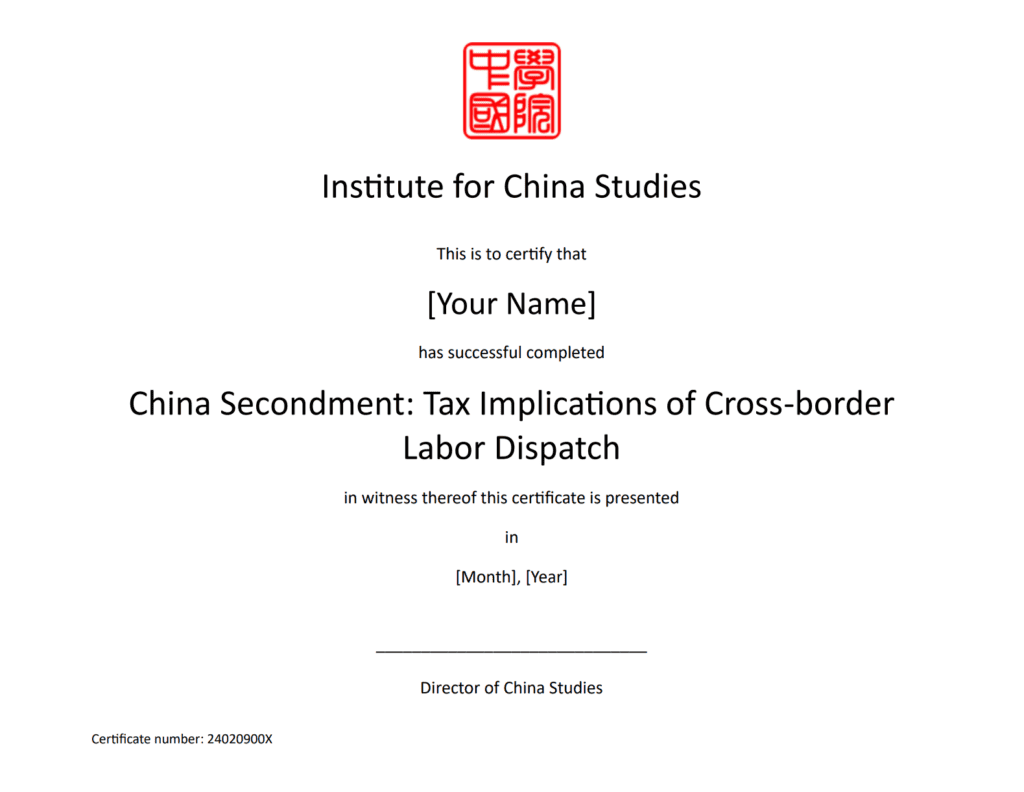
Upon successful completion of the masterclass and the required assessments, you will earn a digital certificate of completion from the Institute of China Studies.
Your certificate provides a formal record of your completion of the program and can be retained as part of your professional learning portfolio.
Official Recognition
Issued by the Institute for China Studies.
Digital Format
Easy to download, share and add to your profile.
Your Course Professor

Dr. Richard van Ostende, DBA
Richard van Ostende is founder of the Institute for China Studies. He combines extensive professional experience and practical expertise in corporate finance, foreign investment and business strategy.
Not Sure Where To Start?
Book a free consultation with us.
Choosing the right program or solution for your organization can be challenging. Speak with an ICS advisor to discuss your objectives, experience and requirements.
Not Sure Where To Start?
Looking for an answer?
You may find the information you need in our Frequently Asked Questions, covering programs, admission, learning pathways, certification, fees and more.
Related Courses
Continue developing your China expertise.

Related Courses
Continue developing your Chinaexpertise.