
Certificate Course
Essentials For Market & Industry Analysis In China
Develop the practical skills to assess market dynamics, competitive forces, opportunities and risks to support informed business decisions.
Certificate Course
10 weeks
approx. 8-10 hours/ week
100% online
Open Enrollment
EUR 899
Course Overview
Over ten weeks, you will develop the knowledge and practical skills required to conduct market and industry research in China. You will gain in-depth insights into a market and industry of your interest, providing a stronger foundation for informed business decisions and strategic planning.
You will examine developments across the Political, Economic, Social, Technological, Legal and Environmental (PESTLE) dimensions at national, provincial and regional levels, assessing their potential impact on your selected market. You will also develop a deeper understanding of China’s dynamic industry environment, learn how to identify current and emerging industry developments, and apply established tools, techniques and best practices for conducting industry analysis.
The course takes a practical, hands-on approach. At the beginning of the course, you will select a Chinese market and industry that you want to understand in greater depth. Using a structured template, you will document your existing knowledge and understanding as the starting point for your research. This becomes a living document, which you will progressively update and substantiate with new research and insights throughout the course.
You will also examine the interrelationship between competitive forces and how they influence industry competitiveness, attractiveness and profitability. By the end of the course, you will have completed a comprehensive market and industry analysis and developed an informed assessment of the opportunities, risks and attractiveness of your selected market and industry. The knowledge, analytical skills and practical experience gained can be directly applied in your professional environment to support market assessment, business development, strategic planning and decision-making in China.
Course Structure
Five Focused Units.
Unit 1: Introduction
The first unit provides an orientation to the course and the online learning environment. The unit does not carry credits. You are encouraged to go through the materials at their own pace to get accustomed to the online medium.
Unit 2: Essential Skills for Market Research
Market research can be conducted through various methods, including desk research, academic and business literature, surveys and expert interviews. This course focuses primarily on in-depth and structured desk research. You will be introduced to the PESTLE framework to structure your market research and assess Political, Economic, Social, Technological, Legal and Environmental factors. You will learn to determine whether these factors represent short-, medium- or long-term opportunities or threats.
Unit 3: Essential Skills for Industry Analysis
Industry research requires a structured approach to collecting and evaluating information from academic, business and other relevant sources. This unit focuses on in-depth desk research as the foundation for industry analysis. You will use the Competitive Forces model to assess the factors shaping industry competitiveness, attractiveness and profitability. You will also learn to evaluate whether these factors represent short-, medium- or long-term opportunities or threats.
Unit 4: International Organizations
International organizations provide valuable research, analysis and forecasts on China’s economic development, markets and industries. You will explore publications from leading international organizations, identify relevant information and learn how to collect, structure, assess and analyze these sources to develop a broader understanding of your selected market and industry.
Unit 5: Sino-Foreign Business Advocacy Organizations
International Chambers of Commerce and other business advocacy organizations play an important role in representing and supporting foreign businesses operating in China. You will examine their role, activities and perspectives on China’s economic and business environment. You will identify relevant research, assessments and recommendations and incorporate these insights into your market and industry analysis.
Unit 6: PRC Organizations
Chinese government and other PRC organizations are important sources of information on China’s current economic conditions and future development plans. This unit introduces China’s administrative structure and explores publicly available information from relevant PRC sources. You will learn how to identify and assess information on national, regional and local markets and industries.
Unit 7: Think Tanks
Think tanks provide research and analysis on economic, political, social, technological and other developments that can influence China’s markets and industries. You will explore publications from Chinese and international think tanks, assess their relevance and incorporate key findings into your research to develop a deeper understanding of market and industry developments.
Unit 8: Additional Data Sources
Having explored international organizations, business advocacy organizations, PRC organizations and think tanks, you will expand your research to additional sources. These include management consulting firms, management and business journals, business school publications, open-access research databases and the Digital Commons Network. You will learn how to evaluate and integrate relevant information into your analysis.
Unit 9: Market Attractiveness
By this stage, you will have collected information on the historical, current and expected future development of your selected Chinese market. You will analyze the findings to identify key trends, opportunities and threats and assess differences between regions and municipalities. The objective is to determine which markets and locations offer the greatest potential for your business.
Unit 10: Industry Attractiveness
You will consolidate the research collected throughout the course to assess the attractiveness of your selected industry in China. Particular attention will be given to China’s regional diversity, as different provinces, regions and municipalities have distinct economic priorities and pillar industries. You will assess how these differences influence the competitive environment, industry attractiveness and potential business opportunities.
Unit 11: Capstone Assignment
The course concludes with a Market and Industry Analysis Report that brings together the research and insights developed throughout the course. The report should be written to a professional standard suitable for presentation to senior management and provide a sound basis for strategic planning, business development and decision-making in the selected Chinese market and industry.
Who Is This Course For?
Professionals who need to understand China’senvironment, evaluate opportunities and risks, and support strategic business decisions.
- Market Entry & Strategy Professionals assessing opportunities in China
- Sales and Business Development Managers identifying markets, industries and growth opportunities
- China Country Managers and Senior Executives involved in strategic planning and decision-making
- Market Intelligence and Research Professionals conducting market and industry analysis
- Business Development and Commercial Managers evaluating competitive environments and market potential
- Consultants and Business Advisors supporting China-related market and industry assessments
- Business Owners and Entrepreneurs considering entry into or expansion within China
Practical Tools Included
This course includes the following tools that can be directly applied in real-work work environments:
- PESTLE Analysis Framework: Assess the political, economic, social, technological, legal and environmental factors influencing China’s market environment.
- Competitive Forces Analysis Template: Evaluate the competitive forces shaping industry attractiveness and profitability.
- Market & Industry Research Template: Systematically collect, organize and assess relevant information.
- Opportunity & Threat Assessment Matrix: Classify developments by potential impact and timeframe.
- China Regional Market Analysis Framework: Compare market conditions and developments across provinces, regions and major cities.
- Industry Attractiveness Assessment: Evaluate industry competitiveness, growth potential and profitability.
- Market Attractiveness Assessment: Assess market potential and identify attractive locations and segments.
- Strategic Planning Framework: Translate research findings into actionable business and market development strategies.
Earn Your Credential
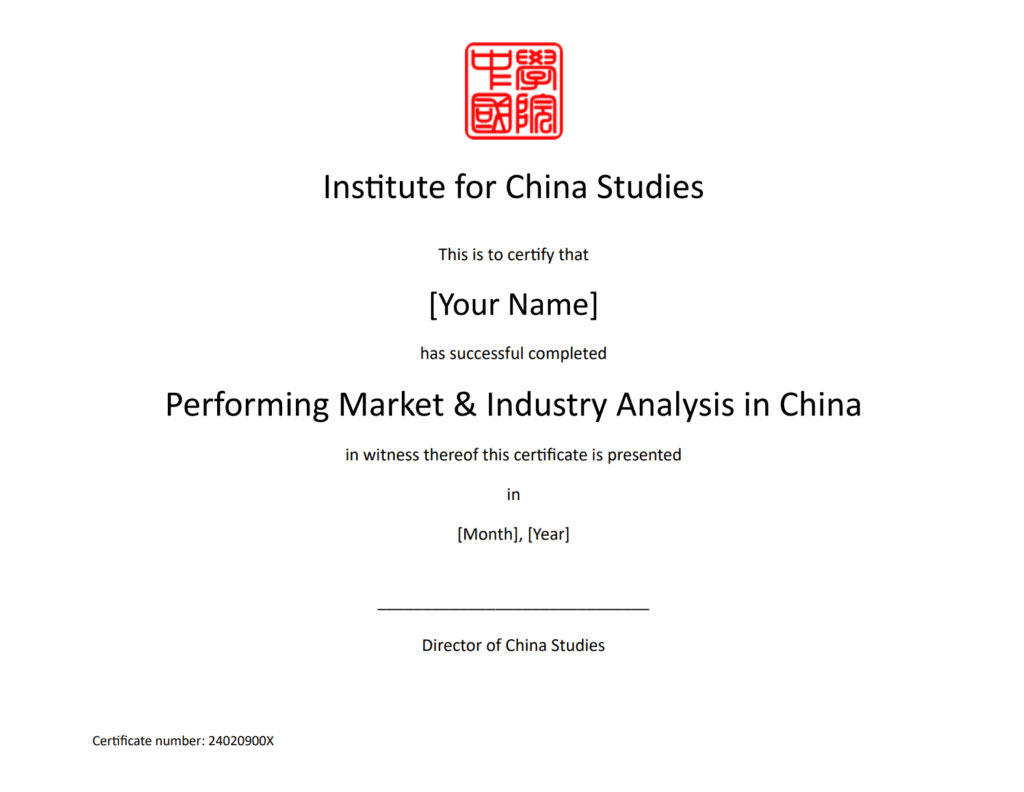
Upon successful completion of the masterclass and the required assessments, you will earn a digital certificate of completion from the Institute of China Studies.
Your certificate provides a formal record of your completion of the program and can be retained as part of your professional learning portfolio.
Official Recognition
Issued by the Institute for China Studies.
Digital Format
Easy to download, share and add to your profile.
Your Course Professor

Dr. Richard van Ostende, DBA
Richard van Ostende is founder of the Institute for China Studies. He combines extensive professional experience and practical expertise in corporate finance, foreign investment and business strategy.
Not Sure Where To Start?
Book a free consultation with us.
Choosing the right program or solution for your organization can be challenging. Speak with an ICS advisor to discuss your objectives, experience and requirements.
Not Sure Where To Start?
Looking for an answer?
You may find the information you need in our Frequently Asked Questions, covering programs, admission, learning pathways, certification, fees and more.
Related Courses
Continue developing your China finance expertise.
Related Courses
Continue developing your China finance expertise.
Related Courses
Continue developing your China finance expertise.
Ready To Take The Next Step?
Target audience
Sales and Business Development Managers, Strategists, Corporate Analysts, and Executives from all industries who have an interest in developing a better understanding of China’s market and industry environments.
100% Online delivery
The course is designed to be completed fully online enabling students to continue working during the course.
Literature
The course covers all literature and materials essential to performing in-depth market analysis in China.
Duration
The standard duration of the course is 10 weeks based on an average time commitment of 8 to 10 hours per week.
Objectives
- You will become experienced in performing market and industry research in a structured and efficient way.
- Develop insight in how China’s market environment is structured and operated on national, provincial, and regional levels, and learn to assess the importance and interconnectivity of different market factors.
- Become able to assess the competitive forces that influence the industry environment and determine its attractiveness.
- Learn to navigate information from sources including but not limited to International Organizations, PRC Organizations, Sino-Foreign Business Advocacy Organizations, Industry Associations, Research Institutes, Business Schools and Management Consultants.
Unit 1: Introduction
The first unit provides an orientation to the course and the online learning environment. The unit does not carry credits. You are encouraged to go through the materials at their own pace to get accustomed to the online medium.
Unit 2: Essential skills to perform market research
Market research can be performed in multiple ways which include but are not limited to desk research utilizing academic, quasi-academic and business literature, conducting surveys, expert interviews, and others. These means of research require a varied skillset. This course focuses on performing in-depth and extensive desk research.
In this unit focus goes out to the PESTLE model that will be used to structure the market research, in combination with the determination whether the factor can be considered a short-, medium- or long-term opportunity, threat or at the time of research cannot yet be decided.
Unit 3: Essential skills for performing industry analysis
Industry research can be performed in multiple ways which include but are not limited to desk research utilizing academic, quasi-academic and business literature, conducting surveys, expert interviews, and others. These means of research require a varied skillset. This course focuses on performing in-depth and extensive desk research.
In this unit focus goes out to the Competitive Forces model that will be used to structure the market research, in combination with the determination whether the factor can be considered a short-, medium- or long-term opportunity, threat or at the time of research cannot yet be decided.
Unit 4: International organizations
In this unit you will explore the analysis, views and recommendations made by globally leading international organizations on China’s economic development and underlying markets.
You will collect, structure, assess the publications by international organizations for relevancy, and analyze the found information to create a broad understanding of the respective market of your interest.
Unit 5: Sino-foreign business advocacy organizations
Chamber of Commerce are organizations established with the purpose to support the promotion and protection of the interests of its members. In mainland China multiple international Chambers of Commerce have been established supporting the foreign business community. In this unit the background of International Chambers of Commerce operating in mainland China is discussed, the business communities it aims to support, international recognition as well as the support activities provided.
In this unit you will explore the held views on China’s economic development and recommendations made by International Chambers of Commerce operating in mainland China. You will collect, structure, assess for relevancy and analyze the found information to create a broad understanding of the respective market of your interest.
Unit 6: PRC organizations
In order to support better informed decisions, in-depth insights into the development of China’s national and regional markets and industries are a prerequisite. A valuable source of information are China’s government websites as these provide information on the current situation, as well as the planned future development of China’s national, regional, and local markets and industries within these markets. In this unit the structure of China’s administrative division is discussed, followed by an exploration of the information made publicly available.
Unit 7: Think tanks
Think tanks are institutes, corporations, or groups organized for interdisciplinary research with the objective of providing advice on a diverse range of policy issues and products through the use of specialized knowledge and the activation of networks. Think tanks are distinct from government, and many are nonprofit organizations, but their work may be conducted for governmental as well as commercial clients. Projects for government clients often involve planning social policy and national defense. Commercial projects include developing and testing new technologies and new products.
In this unit you will explore the publications made by Chinese and foreign Think Tanks to support your market research. You will collect, structure, assess for relevancy and analyze the found information to create a broad understanding of the respective market of your interest.
Unit 8: Miscellaneous data sources
In the past weeks you have explored publications from major information sources International Organizations, Sino-Foreign Business Advocacy Organizations, PRC Organizations and Think Tanks to support your market analysis.
This unit is the last unit which primarily focuses on data collection and information gathering. In this unit you will explore further sources of information which include but are not limited to leading management consultancy firms, management journals, business school journals, open access journal databases and the Digital Commons Network.
Unit 9: Market attractiveness
In the past weeks you have been collecting information on the past, current, and expected future developments from publications by International Organizations, PRC Organizations, Sino-foreign Business Advocacy Organizations and other sources regarding the Chinese market and industry of your interest.
When collecting a substantial amount of information, patterns will emerge. Regions and Municipalities in China have their own economic focus and are often developing multiple pillar industries. Having identified relevant developments, the next step is to determine which locations are of most interest.
Unit 10: Industry attractiveness
In the past weeks you have been collecting information on the past, current, and expected future developments from publications by International Organizations, PRC Organizations, Sino-foreign Business Advocacy Organizations, Think Tanks, Management Consultancy Firms, and other sources regarding the Chinese industry of your interest.
When assessing substantial amounts of information, patterns will emerge. Contrary to common believe, due to its immense size and diversity, there is not a single “China market”. As you have experienced when researching the literature and reading materials material produced by the various sources, China has been structured in regions. Each of these regions (and at a hierarchical lower level the major municipalities located in these regions) each have their own specific economic focus and are often developing multiple pillar industries, hereby shaping their market environments.
Unit 11: Capstone assignment
The Capstone assignment of this course includes the composition of a Market and Industry Analysis report that can be presented to the senior management of your company. The Market and Industry Analysis report should be written at such a quality level that your company can develop strategic planning for developing the desired Chinese market.
Admission
No specific prior education or knowledge about market or industry analysis related to China is required.
Assessment
Assessment is carried out through a series of written assignments to be completed at the end of each unit.
Certificate of Completion
A course certificate is issued upon the successful completion of the course.
Tuition Fee
Tuition fee for the course is EUR 899 to be paid in advance.
The tuition fee includes all necessary literature and study materials, guidance and support during your studies, free extension of the study duration (if required), and 1:1 contact with your course professor.
Start date
Open enrollment applies to this course. You can start this course at a timing of your own convenience.