
China’s Digital Ecosystem: Navigating Platforms, Commerce, and Culture
E-Learning | Certificate Course

China hosts one of the world’s most advanced and distinct digital ecosystems, defined by integrated platform economies, closed-loop consumer journeys, and rapid innovation cycles. This certificate course equips participants with an insightful understanding of the structures, behaviours, and technological forces shaping China’s digital market. Through analytical frameworks, applied case studies, and ecosystem mapping, you will gain the strategic competence needed to evaluate opportunities, design market entry pathways, and adapt global brand playbooks to China’s unique environment in the digital era.
Beyond digital ecosystem, you’ll also explore China’s next-gen consumers, subcultures, and the rise of Guochao pride. You’ll examine the merging of physical and digital retail, the emergence of AI-driven virtual humans, and the strategic expansion of China’s tech giants across the globe. By the end of the course, you’ll understand not just what works in China, but why it works and how to apply these frameworks to your own brand or go-to market entry strategy.
Target audience
This course is designed for international business professionals, marketers, strategists, and entrepreneurs who need a deep, practical understanding of China’s digital ecosystem to evaluate market opportunities, localize brand strategies, and design effective China-focused or China-informed go-to-market plans.
100% Online delivery
The course is designed to be completed fully online enabling students to continue working during the course.
Literature
The course covers all literature essential to acquiring the fundamental knowledge of China’s digital ecosystem
Duration
The standard duration of the course is 4 weeks based on an average time commitment of 4 hours per week.
Upon completion of this course, you will be able to:
- Decode China’s platform-based digital ecosystem, including the strategic roles of Alibaba, Tencent, Bytedance and Xiaohongshu;
- Analyse consumer behaviour and youth subcultures to inform culturally grounded brand strategies.
- Apply full-funnel marketing frameworks within superapps, with emphasis on WeChat, private traffic, and OMO integration.
- Evaluate the impact of algorithmic content systems and influencer structures, including Douyin, KOL/KOC models, and MCNs.
- Develop a market entry or growth digital strategy for China, incorporating regulatory considerations, cross-border pathways, and emerging technologies such as AI and virtual humans.
Unit 0: Introduction — Digital China as Theory, Case, and Reference
This opening unit establishes the conceptual foundation of the course through the “trinity model,” positioning Digital China simultaneously as a theory lens, a real-world case study, and a source of global reference. Participants are introduced to China’s digital ecosystem as a system that challenges Western assumptions about platforms, governance, and consumer behavior. The unit prepares participants to think analytically, comparatively, and strategically as they navigate the rest of the program.
Unit 1: The Platform Economy & the Walled Gardens
This unit explores China’s platform economy as a closed yet highly efficient system dominated by powerful ecosystems such as Alibaba, Tencent, and Bytedance. Participants examine how “walled gardens” shape competition, user journeys, and innovation, contrasting them with open-web models. Through ecosystem mapping and critical reflection, the unit highlights the strategic, ethical, and global implications of platform consolidation in China’s digital landscape.
Unit 2: Decoding the Super app — WeChat
Focusing on WeChat as China’s most influential super app, this unit positions the platform as a socio-technical infrastructure rather than a single application. Participants explore Mini Programs, WeChat Pay, CRM systems, and private traffic logic to understand full-funnel marketing within one ecosystem. The unit also invites critical analysis of how such an all-encompassing platform reshapes commerce, governance, and everyday digital life.
Unit 3: The Interest Commerce Revolution — Tiktok/Douyin & Video Commerce
This unit examines the rise of interest-driven commerce through short video platforms such as Douyin (Tiktok growingly alike). Participants explore how algorithms generate intent rather than simply capture demand, transforming content into conversion engines. By reverse-engineering video commerce funnels and livestream formats, participants gain insight into attention economies while critically reflecting on how algorithmic systems influence desire, consumption, and consumer autonomy.
Unit 4: The Trust Economy — KOLs & KOCs
This unit unpacks China’s influencer ecosystem, focusing on the industrialization of trust through KOLs, KOCs, and MCNs. Participants analyze how credibility, community, and peer endorsement drive purchasing decisions at scale. Through practical strategy design and critical debate, the unit challenges assumptions around authenticity, manipulation, and consumer agency, offering a nuanced understanding of trust-based commerce in China’s digital environment.
Unit 5: Gen Z, Subcultures & Guochao (National Tide)
This unit explores China’s new generation of consumers through the lens of youth subcultures, ACG (Animation, Comics, and Games) communities, and the rise of GuoChao trend. Participants analyze how identity, cultural pride, and digital-native values shape consumption and brand engagement. By mapping subculture personas and campaigns, the unit encourages critical thinking about cultural longevity, geopolitical sensitivities, and the risks of misaligned branding in China.
Unit 6: New Retail & OMO (Online Merge Offline)
This unit examines China’s New Retail model, where online and offline experiences merge into seamless, data-driven consumer journeys. Participants explore QR codes, gamified pop-ups, and hybrid touchpoints that blur physical and digital boundaries. Beyond design practice, the unit critically evaluates the infrastructural, privacy, and scalability challenges of OMO models, questioning how transferable China’s retail innovations are globally.
Unit 7: Metaverse & AI Integration
This forward-looking unit investigates China’s approach to the metaverse, artificial intelligence, and virtual humans within a regulated digital environment. Participants explore AI-generated content, automation, and synthetic media as emerging tools for marketing and engagement. Through scenario-building and ethical reflection, the unit highlights the tension between innovation, regulation, and responsibility in shaping the future of China’s digital ecosystem.
Unit 8: The Digital Silk Road — ChuHai (Going Global)
The final unit shifts focus from China inward to China outward, examining how Chinese platforms expand globally through cross-border e-commerce and international ecosystem building. Participants analyze outbound strategies, platform localization, and risk scenarios shaped by geopolitics and regulation. This unit encourages strategic reflection on how China’s digital models influence global digital trade and reshape the future of platform globalization.
No specific prior education or knowledge is required to be admitted to this course.
Assessment
Assessment is carried out through a series of written assignments to be completed at the end of each unit.
Certificate of Completion
A Certificate of Completion is issued upon the successful completion of the course.
Tuition fee
Tuition fee for the entire course is EUR 499 to be paid in advance.
The tuition fee includes all necessary literature and study materials, guidance and support during your studies, free extension of the study duration (if required), and 1:1 contact with your course professor.
Start date
Open enrollment applies to this course. You can start this course at a timing of your own convenience.
How we deliver value
Program Completion Benefits
Certificate
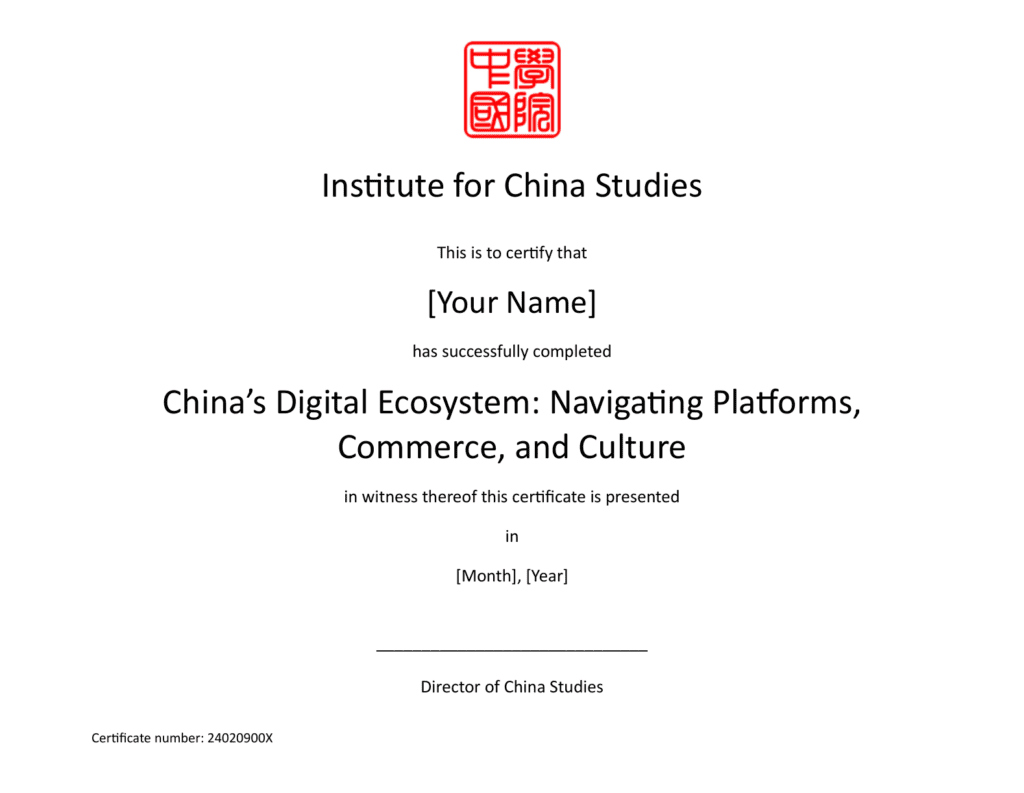
Upon successful completion of the program, you will earn a digital certificate of completion from the Institute of China Studies.
Note: After successful completion of the online program, your verified digital certificate will be emailed to you in the name you used when registering for the program. All certificate images are for illustrative purposes only and may be subject to change at the discretion of the Institute of China Studies.
Contact Us
Would you like more information about the course and the admission requirements? Then request a free study consultation. Of course, free of charge and without obligation. This way you will learn more about the content of the course, the teaching materials, and the online learning environment.
