
Customer Due Due Diligence
E-Learning | Certificate Course

This certificate course on Customer Due Diligence in China is designed to equip professionals with the practical knowledge and analytical frameworks required to conduct robust customer verification and onboarding in China. Failure to properly verify counterparties or align onboarding processes with local regulatory and operational realities can expose firms to significant financial, legal, and reputational risks.
The course combines institutional insight with applied due diligence practices, focusing on company verification, legal authority, tax and invoicing compliance, and payment setup. Participants will learn how to identify red flags, validate counterparties, and establish compliant onboarding processes that align with China’s regulatory and business environment.
The course is particularly relevant for professionals involved in sales, finance, compliance, legal, and business development functions who are responsible for approving customers, setting up contractual relationships, or managing receivables in China.
Target audience
This course is ideal for sales, finance, compliance, legal, and business development professionals responsible for customer verification, onboarding, and risk management when doing business in China.
100% Online delivery
The course is designed to be completed fully online enabling students to continue working during the course.
Literature
The course covers all literature essential for performing new customer due diligence.
Duration
The standard duration of the course is 4 weeks based on an average time commitment of 4 hours per week.
Upon successful completion of this course, you will be able to:
- Understand the institutional and regulatory context shaping customer onboarding and due diligence practices in China.
- Verify the legal existence, ownership, and operational status of Chinese counterparties using authoritative sources.
- Assess legal authority and signing power, including the role and risks associated with company seals and authorized representatives.
- Identify and mitigate onboarding-related risks, including fraud, misrepresentation, and non-compliance.
- Confirm tax, invoicing, and VAT compliance, including correct fapiao types, VAT rates, and invoice information.
- Evaluate payment and banking arrangements, including currency, account location, and approval timelines.
- Apply a structured, repeatable onboarding due diligence checklist suitable for China-focused commercial operations.
Unit 1: Company Verification and Legal Identity in China
This unit provides a practical overview of the business license system in mainland China. Participants will learn the essential characteristics of business licenses and company seals, understand how to verify their authenticity, and apply a verification checklist to identify potential red flags. The unit also addresses common business license scams, highlighting typical fraudulent practices and offering guidance on detecting impostors and protecting your organization.
Unit 2: Legal Authority, Company Seals, and Contractual Risk
This unit introduces participants to the critical role of seals in business compliance and risk management. It explores why sealed documents are binding under Chinese law, how seals differ by function, and why control over a seal can equate to control over the company itself. Participants will also learn about seal management best practices and the risks associated with improper use, unauthorized access, or forgery, one of the most common sources of corporate fraud and legal disputes in China.
Unit 3: Tax, VAT Status, and Fapiao Compliance
This unit provides a practical overview of China’s VAT and fapiao system from a customer onboarding perspective. Participants will learn how VAT status affects invoicing eligibility, pricing, and compliance risk, and how to distinguish between general and small-scale VAT taxpayers. The unit explains the regulatory role of fapiao, outlines mandatory invoice information, and highlights common red flags such as inconsistencies between legal entity data, tax records, and invoice headers, enabling participants to assess whether a customer can issue compliant invoices.
Unit 4: Payment Setup, Banking, and Operational Alignment
This unit examines payment setup and execution risks in the Chinese regulatory and banking environment. Participants will learn how payment currency, onshore versus offshore bank accounts, and foreign exchange controls affect transaction feasibility and compliance. The unit highlights common onboarding risks arising from mismatches between contracts, invoices, and receiving bank accounts, and explains how internal approval processes and authorization structures can impact payment timelines and cash collection.
No specific prior education or knowledge is required to be admitted to this course.
Assessment
Assessment is carried out through a series of written assignments to be completed at the end of each unit.
Certificate of Completion
A Certificate of Completion is issued upon the successful completion of the course.
Tuition fee
Tuition fee for the entire course is EUR 499 to be paid in advance.
The tuition fee includes all necessary literature and study materials, guidance and support during your studies, free extension of the study duration (if required), and 1:1 contact with your course professor.
Start date
Open enrollment applies to this course. You can start this course at a timing of your own convenience.
How we deliver value
Program Completion Benefits
Certificate
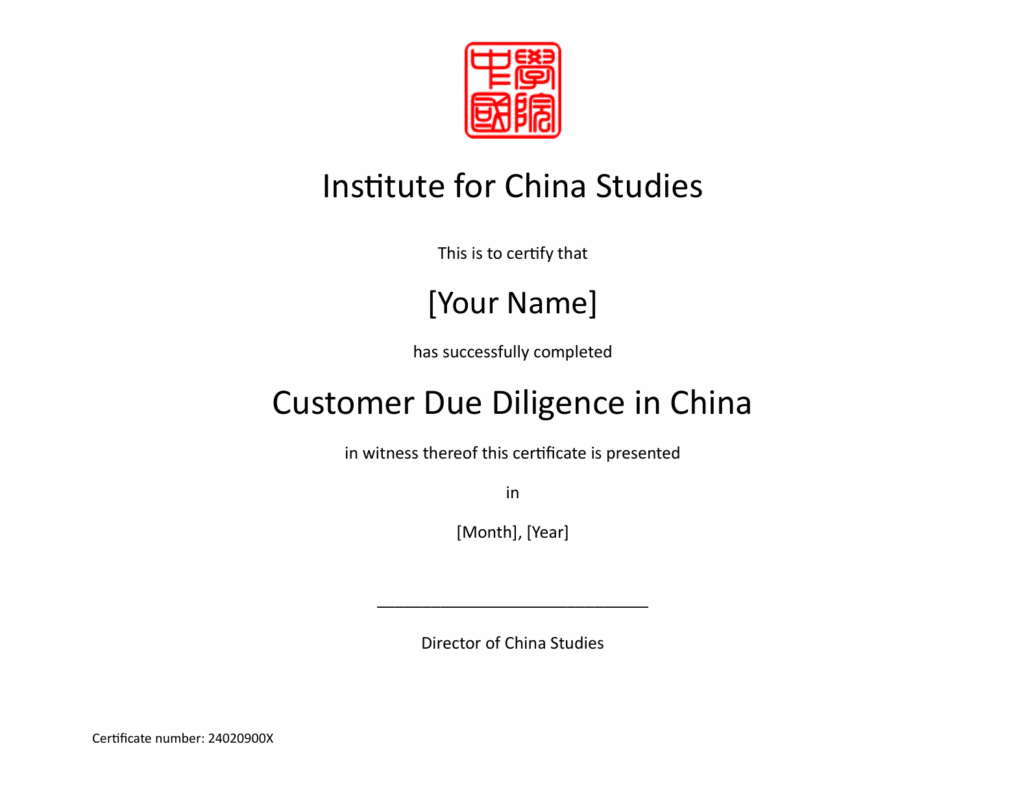
Upon successful completion of the program, you will earn a digital certificate of completion from the Institute of China Studies.
Note: After successful completion of the online program, your verified digital certificate will be emailed to you in the name you used when registering for the program. All certificate images are for illustrative purposes only and may be subject to change at the discretion of the Institute of China Studies.
Contact Us
Would you like more information about the course and the admission requirements? Then request a free study consultation. Of course, free of charge and without obligation. This way you will learn more about the content of the course, the teaching materials, and the online learning environment.
